

"The SOC was built to process alerts at human speed. The adversary just stopped waiting."
For years, the defining problem in security operations was volume. Too many alerts, too many false positives, too few analysts. The industry built an entire generation of tooling around that problem: SIEM platforms to aggregate, SOAR platforms to automate playbooks, detection engineering to tune signal-to-noise. The assumption underneath all of it was that if we could just surface the right alerts to the right people fast enough, humans would make the right calls.
That assumption held as long as attackers operated at human speed. It does not hold anymore.
In July 2026, Sysdig's Threat Research Team published their analysis of JadePuffer, the first documented fully agentic ransomware operation. An LLM agent ran the entire kill chain autonomously: reconnaissance, credential theft, lateral movement, persistence, privilege escalation, encryption, database destruction, and ransom note delivery. The agent executed over 600 distinct, purposeful payloads in a compressed window. The detail that defines the new era: when a login attempt failed, the agent recovered and found a working alternative in 31 seconds. No human operator was in the loop on the attacker's side. The machine adapted faster than most SOC teams can open a ticket.
The CrowdStrike 2026 Global Threat Report found that average eCrime breakout time fell to 29 minutes in 2025, a 65% increase in speed over the prior year, with the fastest observed breakout ever recorded at 27 seconds. The IBM 2025 Cost of a Data Breach Report put the global average breach cost at $4.44 million, with organizations using AI and automation extensively saving approximately $1.9 million per breach and cutting the breach lifecycle by roughly 80 days. The economics are clear. Speed is not an optimization. It is the variable that determines whether a security event stays an incident or becomes a breach.
We have watched this shift from inside production security programs. Tushar Badlani is a Security Specialist at Figma, focused on Customer Trust and Third-Party Risk. Mohit Bansal is a Senior Manager of Security Engineering at Webflow. Between us, we have spent years building the detection pipelines, SOAR integrations, and triage workflows that enterprises depend on. The pattern we keep seeing is the same: the detection works, the enrichment works, the alert fires on time. And then the response stalls, because a human has to decide what to do next, and the adversary does not wait for that decision.
The real vulnerability is not the alert. It is the gap after it
The alert fatigue numbers are real and well documented. The Vectra AI 2026 State of Threat Detection report surveyed 1,450 practitioners and found an average of 2,992 alerts per day, with 63% going unaddressed. The SANS 2025 Detection and Response Survey reported that 73% of teams name false positives as their top detection challenge. Tines' Voice of the SOC Analyst report found 71% analyst burnout, with 64% considering leaving within a year.
Those numbers describe a human endurance failure. Analysts are overwhelmed, desensitized, burned out. That is serious, and it has been serious for years. But it is not the failure mode that JadePuffer exploits.
What JadePuffer exploits is an architecture failure. The time between "the alert fires" and "an authorized action executes" is where the adversary operates. In a traditional SOC workflow, that gap includes alert triage, context gathering across multiple consoles, severity assessment, escalation, approval, and finally action. The Microsoft and Omdia State of the SOC 2026 report found that teams manage an average of 10.9 consoles. Each console switch, each enrichment query, each escalation conversation adds seconds and minutes to a loop that the adversary is completing in seconds.
The distinction matters because the two failure modes demand different solutions. Alert fatigue is addressed by better detection engineering: tuning rules, reducing false positives, improving signal quality. Decision latency is addressed by redesigning the response architecture itself, specifically by removing the human from the path where speed is decisive and keeping them where judgment is decisive.
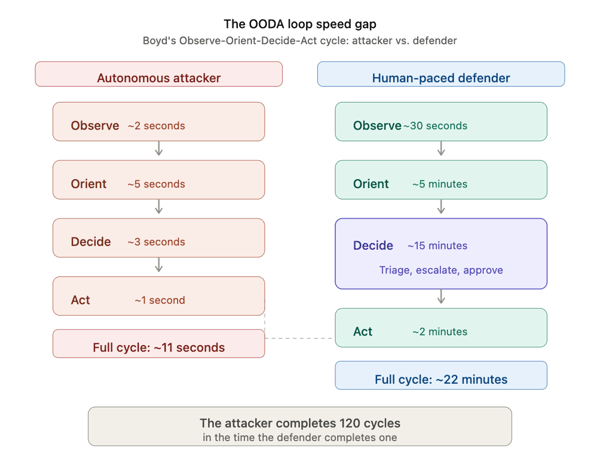
Anthropic's disclosure of campaign GTG-1002 in November 2025 made the asymmetry concrete. The threat actor leveraged AI to execute 80 to 90 percent of tactical operations independently, at physically impossible request rates, with human intervention required only at roughly four to six critical decision points per campaign across approximately 30 targets. The attacker's OODA loop, the Observe-Orient-Decide-Act cycle that fighter pilot John Boyd formalized for competitive engagements, was cycling in seconds. The defender's loop was cycling in minutes to hours.
When the adversary's full loop is faster than your single "Decide" step, you have already lost the engagement. That is decision latency. And no amount of better detection fixes it.
The reversibility principle
The instinct when confronting this speed gap is to automate everything. Let the machine match the machine. Remove the human entirely. That instinct is understandable, and it is wrong.
Not every security action is the same. Enriching an alert with threat intelligence context is a low-risk, instantly reversible operation. Isolating a production host from the network is high-impact and, depending on what that host serves, potentially irreversible in its business consequences. Revoking a credential is somewhere in between, depending on what the credential protects and whether re-issuance is automated.
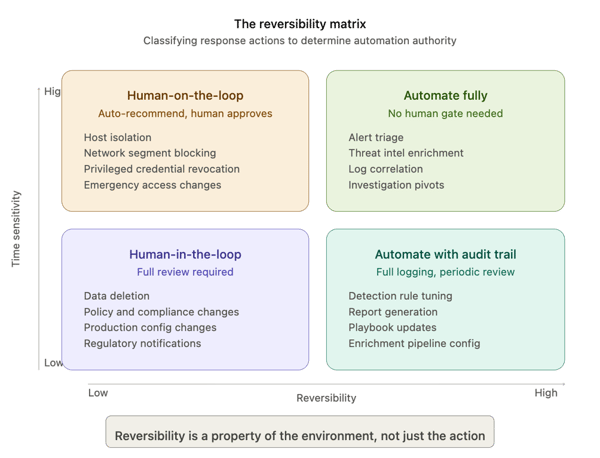
The teams that are navigating this well tend to classify their response actions not by severity tier or alert type, but by reversibility. The question is not "how serious is this alert?" The question is "if the automated response is wrong, how hard is it to undo?"
A Microsoft Security Copilot study (randomized controlled trial, 167 analysts, published November 2025) found that agent-augmented analysts achieved up to 6.5 times as many true positives per analyst-minute and a 77% improvement in verdict accuracy. They spent 53% more time on genuinely malicious signals. The gains came not from removing the human, but from removing the human from the parts of the loop where speed matters more than judgment, and redirecting human attention to the parts where judgment matters more than speed.
This is the architectural principle that resolves the tension between "automate for speed" and "keep humans in control." Reversible, high-volume actions go to the machine: alert triage, multi-source enrichment, investigation pivots, detection rule drafting, log correlation, threat intelligence lookups. Irreversible, high-blast-radius actions stay with a human: credential revocation for privileged accounts, production host isolation, network segment blocking, data deletion, configuration changes that affect availability.
The common thread in our operational experience is that the distinction between reversible and irreversible actions is not always obvious upfront, and the classification has to be maintained as the environment changes. A credential revocation that is trivially reversible in an environment with automated re-issuance is effectively irreversible in an environment where re-provisioning takes a support ticket and two business days. The reversibility of an action is a property of the environment, not just the action itself.
Gartner has labeled standalone SOAR "obsolete before plateau" on high total cost of ownership, with capabilities folding into SIEM, XDR, and agentic platforms. The 2025 Hype Cycle for Security Operations placed "AI SOC Agents" at just 1 to 5 percent market penetration. The tooling is early. But the architectural pattern, classifying actions by reversibility and granting autonomous authority only for the reversible majority, does not require any specific vendor. It requires a design decision.
Earning autonomy, not granting it
The practical challenge is that most organizations cannot flip a switch from "human approves everything" to "machine acts autonomously on reversible actions." The trust has to be earned, and the earning has to be measurable.
The pattern that works in practice is staged rollout with confidence thresholds. An AI triage agent starts in shadow mode: it processes every alert and generates a recommendation, but takes no action. The team compares the agent's recommendations against their own decisions over a defined period. When the agent's accuracy on a specific alert type crosses a predefined threshold, verified against the team's own ground truth, it earns autonomous authority for that alert type only.
This is not theoretical. CrowdStrike reports that their Charlotte AI Detection Triage saves more than 40 hours per week with greater than 98% triage accuracy. Microsoft's Security Alert Triage Agent reports up to 78% faster triage. Those numbers are vendor-reported and should be treated accordingly, but the directional signal is consistent: supervised automation on well-defined alert types produces reliable results faster than human-only workflows.
The risk of staged automation is not that it moves too fast. The risk is that it erodes analyst skill. If the machine handles 80% of triage, the 20% that reaches human analysts needs to include a representative sample of the machine-triaged alerts, not just the hardest cases. Periodic raw-alert work prevents the kind of automation complacency where analysts lose the ability to evaluate what the machine is doing. The teams that maintain this discipline tend to catch drift earlier.
Our security programs have invested heavily in SOAR pipeline automation, SIEM log correlation, and threat alert enrichment with AI-assisted triage. The operational lesson is consistent: the automation that works is the automation that was measured before it was trusted, that operates within explicit boundaries, and that produces a full audit trail of its reasoning. The automation that fails is the automation that was deployed under time pressure with implicit boundaries and no mechanism for the team to verify its decisions after the fact.
The broader industry is converging on the same conclusion. A Forbes Tech Council piece from March 2026 framed it sharply: "Human-in-the-loop is not a feature. It is a power structure." Exercising irreversible authority before uncertainty has a clear owner is a design failure, not a model failure. But the inverse is also true: forcing a human gate in front of machine-speed reversible actions hands the tempo advantage back to the attacker. The shift is from human-in-the-loop as a blanket policy to human-on-the-loop as a guardrailed architecture, with the guardrails drawn by reversibility.
Where this leaves us
Decision latency is not a new metric to add to the dashboard. It is a reframe of what the SOC is actually defending against. The threat model has shifted from "we might miss the alert" to "we will see the alert and not act fast enough." The difference is architectural, not operational.
The tools to address decision latency exist. Action classification by reversibility is not experimental. Staged automation with confidence thresholds is not a research problem. Runtime audit trails of agent reasoning are achievable with current infrastructure. What is missing is the organizational decision to redesign the response architecture around the speed of the adversary rather than the comfort level of the approval chain.
The teams that will weather the next generation of autonomous threats are the ones measuring decision latency today, classifying their response actions by reversibility, and earning autonomous authority through measured performance rather than granting it by default. The adversary is not going to slow down. The only variable the defender controls is how fast the response loop closes. And right now, for most organizations, the slowest agent in the room is still human.
This article was co-written by Mohit Bansal.