

I talk to a lot of organizations that are being pressured from their board or upper leadership to implement AI for fear of getting left behind. These organizations have staff who are eager to use more and different AI tools than those sanctioned by the company. So, where is the disconnect for the leadership's command for innovation, employees taking ownership, and higher productivity from the staff?
Roger Smith, CEO of GM in the 80s, famously referred to the managerial dysfunction of his company as "rotten in the middle." General Motors was being challenged by the innovative manufacturing approaches of the Japanese automakers. And, while he wanted to see change, his middle managers didn't—which perfectly describes the sandwich hindering innovation above. And yes, he is the "Roger" from Michael Moore's 1989 documentary, Roger & Me.
Salesforce reports 50-60% of workers use unsanctioned AI. Many reports talk about lack of ROI we are seeing from AI deployments, and that is just the small percentage of initiatives that make it past all the approval gates into production.
I have seen fear by middle management that they might lose their organizations, influence, control over data, control over decisions or staff that they fought to acquire over years. Yet, they don't want to be seen as being directly against AI, since it's an upper leadership mandate, so it causes them to put in more bureaucracy disguised as governance, and hierarchy disguised as new "AI initiative onboard request portals" and approval workflow.
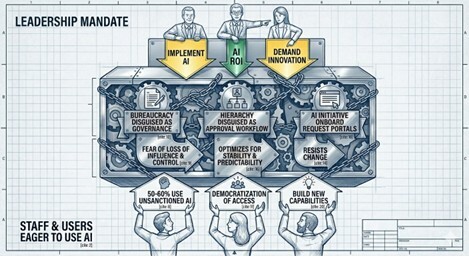 Image prompted by Rick Doten and generated by Gemini.
They are threatened by democratization of access to information, engineering, project management, and expertise. Middle management's expertise is built on controlling how the staff communicates, collaborates, and makes decisions. AI disrupts this.
But Roger isn't the only one to describe this dysfunction, and it has been seen in many large organizations for decades. We have concepts in books talking about this like the Organizational Immune Response, where, like the human immune system, organizations resist change or anything disruptive. It optimizes for control, efficiency, and predictability. This is from the work of Clayton Christensen and Gary Hamel in the late 1990s, where they see bureaucracy suppress innovation to maintain homeostasis with the rest of the organization. And the Competing Values Framework, where workers are given competing values of innovation versus stability, or flexibility versus control, that organizations seek, but the reality is they favor the latter. This is by Robert E. Quinn and John Rohrbaugh's work in the early 1980s.
And even today when it comes to AI rollout, McKinsey1, Deloitte2, and Boston Consulting3 all published reports in the last year indicating that middle management is a barrier to AI adoption.
When we talk about staff displacement, the narrative is focused on the bottom, because AI can automate basic tasks; and we are seeing huge unemployment in college graduates. But the reality, which we haven't broadly realized in practice yet, is we NEED the bottom to fill in with people willing to find new ways to accomplish tasks absent legacy cultural baggage and build new capabilities.
It's the middle that is at real risk. Right now, they are controlling budget, project prioritization, hiring decisions, and tech procurement sign-offs, which helps them control pace of new technology that threatens them.
This challenge is separate from the broader issue of AI being impeded by implementation challenges. Managers blamed model maturity, data quality, or lack of AI architecture frameworks as reasons for lack of success. But the major AI labs have recently reported the technical barriers are largely solved, and the real obstacle is organizational willingness to transform.4, 5, 6
And the other huge gap is there aren't enough people who know about AI implementation and tools to support everyone who needs help. There is great FOMO by large U.S. companies that see these small Silicon Valley tech companies 10x their productivity and revenue per person and feel they are behind. But reality is that is a very small percentage who are winning with AI. And those who are winning are fortunate enough to start from scratch. It's hard to convert your sailboat to a motorboat while it's skimming across the water.
Most organizations are still struggling to figure out their strategy, plan, and what success looks like. This is because there is no one right answer, there is only the right answer for your organization. And that will be different in six months, and again in a year. The rapid change is another huge challenge for organizations—and opportunity for middle management to balk: "the new models change our approach, let's do another analysis and present how it changes our plan in next month's steering committee."
So, what do we do? As I talked about in my previous article on how AI changes leadership, I illustrate that if people are now orchestrating agents to do work, and not doing the work themselves, then we grade their performance differently. We need to do the same for middle management. We need to measure them on having the right roles and experience on their staff, on making sure they are tracking AI costs (tools, tokens, SaaS API costs, etc.), and getting these projects through approval so they can get started. We should measure on how many AI pilots got started, how many made it to production, what tools were operationalized, and what projects are giving business ROI.
These are AI enablement metrics. And this flips the incentive. Managers see that AI is helping them get more influence, staff, and recognition for successful projects. Have monthly "Shark Tank" like pitches for staff to highlight the projects they are working on, rewarding those who have ideas that can be operationalized. The middle managers who succeed and survive this transformation will be the ones who become their organization's AI translation layer, helping execute their leadership's ambition and supporting the staff to do so.
References:
1 McKinsey SuperAgency in the Workplace: Empowering people to unlock AI’s full potential, January 2025
2 Deloitte AI Trends 2025: Adoption Barriers and updated predictions, September 2025
3 BCG-BHI AI Adoption Puzzle: Why Usage Is Up But Impact Is Not, December 2025
4 Anthropic (via Turing.com)
5 OpenAI (via Valasys Media)
6 Google Deepmind