

The emergency operations center of a major regional power utility went dead at 2:14 a.m.
There was no physical explosion, no severed fiber cable, and no natural disaster. On paper, every enterprise security control had passed its annual audit with flying colors. Firewalls were active, data at rest was encrypted using AES-256, multi-factor authentication was strictly mandated, and compliance frameworks were meticulously aligned.
Yet, within 45 minutes, cascading control failures across interconnected operational technology (OT) networks, telemetry ingestion pipelines, and automated cloud load-balancers plunged millions into darkness.
When catastrophic cyber disruptions strike modern infrastructure—whether energy grids, global financial hubs, healthcare networks, or logistics systems—the immediate human instinct is always the same: boot it back up, bypass the friction, and restore operations as fast as possible. The pressure from executive boards, regulatory authorities, and panicked end-users creates an environment where engineering teams naturally scramble toward ad-hoc, rapid recovery based purely on business urgency.
However, frontline response teams know a painful truth: technical restoration does not equal trust.
Flipping switches back on without a strict, dependency-driven strategy is precisely how reinfection vectors are triggered. When systems are brought online out of order, compromised service accounts reconnect, unverified database states sync across healthy nodes, and latent malware payloads execute with elevated privileges.
To bridge the dangerous chasm between initial incident containment and safe business reactivation, a team of veteran cyber resilience leaders developed the Critical IT Services Restart Framework Handbook (v1.0)—co-authored by Francesco Chiarini, Patrick Lechner, and Shwetha Babu Prasad, alongside key contributors Saketh Varma Namburi, Alex Sharpe, and Jordan Schoenherr.
Published as an open, vendor-neutral publication by the Cyber Resilience Manifesto (licensed under CC BY-NC 4.0), the framework introduces a disciplined model for post-incident restoration. It rejects chaotic urgency in favor of an iterative, dependency-driven sequence that validates compromised identities, data integrity, and security monitoring before any system reconnection takes place.
The fundamental guiding philosophy of the framework is simple yet transformative: You do not recover systems based on how loud a department screams for their data; you recover systems strictly based on technical prerequisites.
The core architecture: decoupling urgency from dependency
When an enterprise estate collapses under a major cyberattack, recovery cannot be treated as a single "big-bang" boot event. Simultaneous mass reboots amplify operational instability, obscure active threat vectors, and introduce severe lateral reinfection risks.
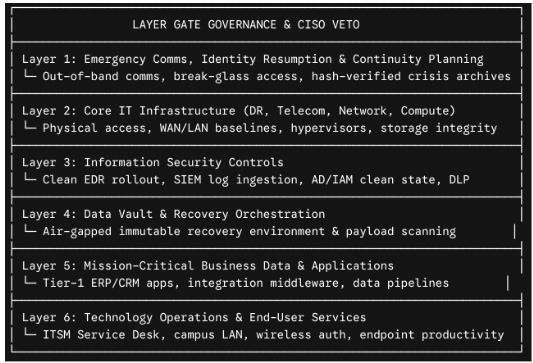
The Restart Framework resolves this by grouping technology services into six distinct, tightly-governed recovery layers. Each layer functions as a mandatory gate threshold: progression to the next layer is strictly prohibited until the preceding layer meets concrete operational and security baselines.
 Grounding recovery in 11 architectural principles
The operational logic of the handbook rests on 11 foundational architectural principles forged from frontline breach recovery experience:
-
Safety before speed: Recovery performance metrics prioritize operational stability and threat eradication over commercial speed or arbitrary executive deadlines.
-
Validated trust in human and technical systems: Every administrative credential, system configuration file, and user permission right must be aggressively audited before reintroduction into production.
-
Minimum viable operations first: Focus immediate recovery actions on re-establishing core operational survival baselines (Minimum Viable Business) rather than full operational feature sets.
-
Security controls as recovery prerequisites: EDR tooling, perimeter segmentation walls, and real-time SIEM logging must be fully operational prior to reviving target business applications.
-
The brownfield vs. greenfield hybrid balance: While traditional guidance often recommended building a completely greenfield environment from scratch, the Restart Framework favors a pragmatic hybrid model. Hardened core nodes (Identity, PKI, Data Vaults) are rebuilt greenfield in isolated environments, while the broader estate is decontaminated and remediated brownfield using live forensics, telemetry analysis, and targeted EDR eradication—saving weeks of downtime without sacrificing security.
The technical layered execution matrix
The operational heartbeat of the handbook is its sequential technical matrix, detailing the precise order of activation, illustrative Recovery Time Objectives (RTOs), and mandatory criteria required before service restoration.
Layer 1: Emergency Communications & Continuity (RTO: ~0.5h per service)
Before any technical recovery begins, response teams must establish safe communication channels.
-
1.1 Out-of-Band Channels: Activation of non-SSO, third-party-hosted voice/text channels for key recovery personnel.
-
1.2 Emergency Access Process: Break-glass administrative access workflows established with crisis leadership.
-
1.3 Crisis Response Archive: Isolation and hash-verification of offline recovery archives and PAM authentication tools.
-
1.4 Internal User Communications: Setup of dedicated broadcast channels (SMS/out-of-band portals) for employee guidance.
Layer 2: Core IT Infrastructure - Telecom, Network & Compute (RTO: 0.5h – 2h)
Restores physical and logical access to underlying data center networks and compute layers.
-
Telecom & Facility Access (2.1): Physical entry to data center facilities confirmed safe.
-
Network & Perimeter Transport (2.2): Restoration of baseline configurations for enterprise WAN/LAN circuits, firewalls, core DNS, DHCP, and NTP platforms.
-
Compute & Virtualization (2.3): Hypervisors restored from clean images, storage arrays (SAN/Cloud/SAP Basis) validated clean, and baseline enterprise monitoring agents deployed across all compute nodes.
Layer 3: Information Security Controls (RTO: 2h – 4h)
Re-establishes security visibility and access controls before application layers are initialized.
-
EDR & SIEM Ingestion (3.1 & 3.2): EDR deployed across servers, OT workstations, and end-user devices; SIEM log ingestion verified.
-
Active Directory & Identity Resumption (3.4 & 3.5): AD Domain Services restored to a verified clean state; dormant or compromised credentials purged prior to unlock; PKI root and issuing certificate authorities validated.
Layer 4: Data Vault & Recovery Orchestration (RTO: ~4h)
Acts as the secure air-gapped staging ground. Systems and database backups are transferred into an immutable recovery vault, scanned for hidden threat actor persistence, and validated clean before promotion into production environments.
Layer 5: Mission-Critical Applications & Pipelines (RTO: 4h – 8h)
Executes prioritized application recovery. Core enterprise applications (ERP, banking ledgers, grid dispatch platforms) are restored, followed by API gateways, middleware, and automated ETL data integration pipelines.
Layer 6: Technology Operations & End-User Services (RTO: 2h – 8h)
Brings general IT operational capabilities back to end-users. Includes Service Desk ticketing systems, campus LAN switches, office productivity suites, wireless 802.1X authentication, and executive support services.
Governance gates, bilateral attestation and community access
The transition from containment to operational recovery is fundamentally a governance challenge.
Technical layers cannot auto-advance based solely on automated scripts. The Restart Framework enforces formal Governance Gates between each phase. 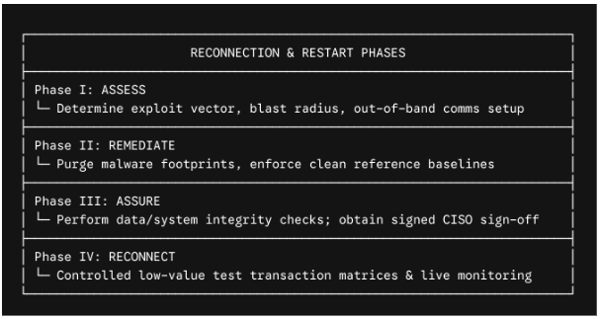
Executive accountability and bilateral attestation
Under the framework's governance protocol, the Chief Information Security Officer (CISO) and the Executive Recovery Governance Committee maintain explicit, unilateral veto power at every single layer threshold.
If telemetry in Layer 3 indicates anomalous lateral service account behavior while Layer 5 applications are staging, the CISO can instantly freeze progression.
Furthermore, returning services to full production and reconnecting external supply chain partners requires an authenticated Bilateral Attestation. Adapted from international financial resilience standards (such as the UK CMORG Reconnection Framework), this protocol ensures both the restoring organization and its external partners execute signed attestations verifying system hygiene, residual risk acceptance, and monitoring compliance before data pipelines open.
Moving from policy compliance to real-world Resilience
Catastrophic cyber breaches are inevitable in interconnected modern digital ecosystems. Compliance checklists and static policy binders are no longer sufficient to guarantee survival. Organizations must build active, engineering-driven resilience protocols that function under maximum stress.
The Critical IT Services Restart Framework provides cyber leaders, infrastructure teams, and executive boards with a common language, realistic RTO metrics, and an auditable road map to move safely from total blackout to restored operational trust.
Download the complete open-source framework
Published as a 100% vendor-neutral community resource, the full handbook and its accompanying editable recovery matrix are available for free.
Download the complete documentation and the customizable Critical IT Services Restart Framework Spreadsheet (v1.0 XLSX) at cyberresiliencemanifesto.org/restart-framework.