
When NIST finalized its initial post-quantum cryptography (PQC) standards—FIPS 203 (ML-KEM), FIPS 204 (ML-DSA), and FIPS 205 (SLH-DSA)—most engineering roadmaps immediately prioritized network transport: post-quantum TLS handshakes and quantum-safe VPNs.
That focus overlooks where cryptographic debt runs deepest: the enterprise identity stack.
Single sign-on (SSO) frameworks, federated identity meshes, and privileged access boundaries depend on asymmetric schemes, specifically RSA and ECC, that fall directly to Shor's algorithm. Upgrading identity systems to post-quantum standards is not an ordinary certificate renewal. The mathematics of lattice-based algorithms introduce payload expansion that will break enterprise federations long before cryptanalytically relevant quantum computers arrive.
The transport bottleneck: token bloat in HTTP headers
Classical federations operate on lean cryptographic footprints. An ECDSA P-256 signature requires roughly 64 bytes; RSA-2048 takes 256 bytes. Because these signatures are small, enterprise identity architectures have spent two decades passing signed bearer tokens inside URL query strings, cookies, and HTTP request headers. Lattice-based digital signatures alter that equation entirely: 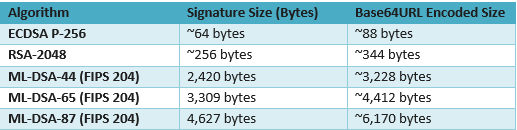 When an Identity Provider (IdP) signs an OpenID Connect (OIDC) JSON Web Token (JWT) using ML-DSA-65, the signature alone consumes 4.4 KB once Base64URL-encoded. Add standard enterprise claims user identifiers, directory groups, tenant scopes, and role assignments and that single bearer token easily exceeds 7 KB.
Placing a 7 KB token into an Authorization: Bearer <token> HTTP header collides directly with common infrastructure limits:
-
Reverse proxies and ingress controllers – Default configurations in NGINX, Apache, and standard API gateways routinely cap request headers between 4 KB and 8 KB (LimitRequestFieldSize or large_client_header_buffers). Oversized headers immediately trigger 400 Bad Request or 413 Request Entity Too Large drops.
-
Web Application Firewalls and load balancers – Most cloud load balancers and WAFs enforce a combined request-header limit of 8 KB to 16 KB. A post-quantum access token competing for header space with session cookies and tracking headers will cause intermittent gateway drops.
-
SAML redirect bindings – SAML 2.0 implementations passing compressed assertions over HTTP GET queries (HTTP-Redirect) face browser and proxy URL limits of 2 KB to 4 KB. Post-quantum signatures make redirect bindings impossible without migrating workloads to HTTP-POST bindings.
-
Privileged access proxies – Privileged Access Management (PAM) jump-hosts and terminal proxies often rely on embedded authentication parsers designed with hardcoded buffer limits, creating stability issues when processing larger identity payloads.
The hardware bottleneck: HSMs and lattice math
The problem extends down to the physical root of trust. Enterprise Certificate Authorities (CAs) and token-minting platforms offload signing keys to Hardware Security Modules (HSMs) through PKCS#11 interfaces.
Most HSMs currently deployed across corporate datacenters contain ASICs hardwired for RSA modular arithmetic and elliptic-curve point multiplication. They cannot process the polynomial and lattice operations required by ML-DSA or ML-KEM without dedicated firmware updates or full hardware replacements.
If an IdP is forced to mint post-quantum assertions before its HSM tier is upgraded, architects face an unacceptable choice: drop signing down into software memory violating FIPS 140-3 Level 3 compliance mandates or halt modernization while waiting through multi-year hardware refresh cycles.
The dual-stack trap: hybrid composite signatures
Enterprises cannot modernize every relying party simultaneously, making dual-stack hybrid signatures unavoidable during migration.
To protect against retroactive decryption while maintaining backward compatibility, hybrid tokens carry both a classical signature (e.g., ECDSA) and a post-quantum signature (e.g., ML-DSA). While this guarantees interoperability across legacy relying parties, composite tokens compound the payload problem, accelerating edge drops and protocol timeouts.
Architectural playbook: preparing the identity stack for PQC
Solving this requires decoupling token verification from public frontend transport.
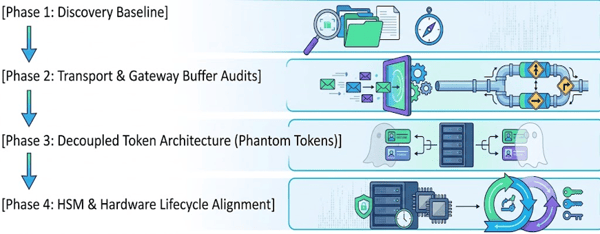
1. Establish a cryptographic discovery baseline
You cannot migrate dependencies you cannot trace. Identity teams should systematically audit:
-
Internal and partner SAML metadata files to document key lengths, signing profiles, and digest algorithms
-
Token-minting key lifecycles and rotation intervals across all enterprise IdPs
-
Machine identity frameworks, including mutual TLS (mTLS) anchors, service mesh CAs, and internal code-signing roots.
-
PKCS#11 implementations to map HSM firmware readiness across physical and cloud estates
2. Re-engineer edge buffers and bindings
Edge infrastructure must be calibrated before deploying PQC-capable credentials:
-
Adjust HTTP request header buffers on ingress controllers, load balancers, and API gateways to at least 16 KB or 32 KB where permissible.
-
Audit SAML configurations and retire HTTP-Redirect bindings, shifting to HTTP-POST bindings so assertions travel inside the HTTP request body rather than query strings.
3. Decouple transport with the phantom token pattern
The most resilient engineering pattern against post-quantum token bloat is the Phantom Token Pattern:
-
Frontend (Client-to-Gateway) – The client application receives a short, lightweight, cryptographically random reference token (an opaque string resembling a standard GUID). This reference token travels in the HTTP Authorization header, keeping request sizes tiny (under 500 bytes) and completely immune to gateway buffer limits.
-
Backend (Gateway-to-API) – When the request hits the enterprise API gateway or reverse proxy, the gateway performs backchannel token introspection with the IdP, retrieving the full, post-quantum signed JWT across an internal, optimized service network.
This design allows security teams to deploy full post-quantum verification at the identity tier without requiring immediate updates to every perimeter proxy, web client, or upstream edge device.
4. Align HSM procurement with FIPS 203/204 roadmaps
Security leaders must make post-quantum cryptographic agility a mandatory vendor requirement:
-
Review physical and cloud HSM deployments to determine which hardware units support firmware upgrades for FIPS 203/204/205 versus which require physical lifecycle replacement.
-
Require commercial IdP and PAM vendors to provide contractual delivery dates for modular cryptographic agility, ensuring software platforms can adopt new algorithms via configuration rather than architectural re-engineering.
Pragmatic preparation
The post-quantum transition in enterprise identity is dictated by operational mechanics, not quantum mechanics. Resolving header bloat, updating gateway buffers, refactoring SAML bindings, and refreshing hardware roots across distributed environments will take years of coordinated systems engineering. Organizations that wait for functional quantum processors will face broken federations, rejected tokens, and unmanageable technical debt.
Addressing these dependencies today preserves system stability, maintains uptime, and ensures identity architectures remain resilient in the post-quantum era.