

If a stranger walked into your organization headquarters with no ID badge, no background check, and no manager who'd requested them, security would stop them at the door. Every time, without exception.
Now consider that the same thing happens with AI agents in your production environment, your customer database, your financial systems, almost every single day. No verified identity. No sponsor. No access boundary. No exit process once the job is done. And somehow, nobody stops it at the door.
We would never allow this with people, but we are allowing it with agents constantly. Why?
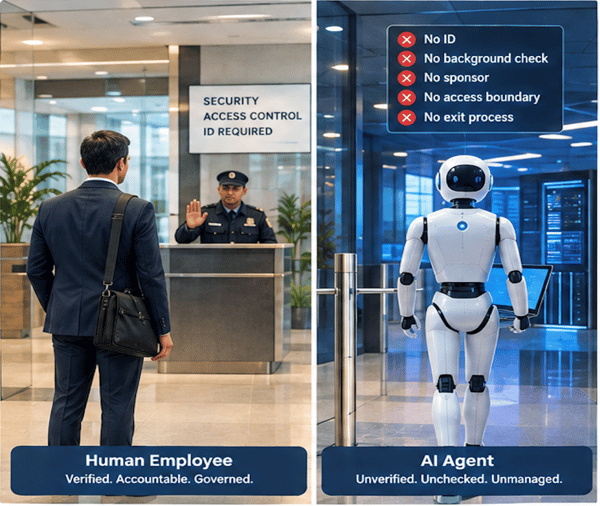
Every person who joins an organization goes through a governance lifecycle that is built over decades.
-
Vetted identity: background checks, verified credentials, a badge tied to a real person
-
Onboarding: role definition, least-privilege access, manager sign-off
-
Access management: periodic recertification, access tied to role changes, monitoring for anomalies
-
Offboarding: immediate deprovisioning the moment someone leaves or changes roles
It is the governance structure that lets an organization scale without scaling risk. It works because every human in the building is someone, accountable to someone, for a defined reason.
AI agents are quickly becoming a second workforce inside our organizations. They provision access, call APIs, move data, and increasingly make decisions on their own. Yet, most are spun up with none of that governance lifecycle. A developer creates an agent for a proof of concept, gives it a service account with broad permissions to make it work, and six months later nobody remembers it exists, what it can touch, or why it was ever allowed to touch it.
That agent is the ungoverned employee wandering the halls of systems. The only real difference is that it never gets stopped, because we never built an exit door for it in the first place.
If you wouldn't let an unvetted stranger walk in and start accessing your systems, why would you let an unvetted agent be created without the same discipline?
A mature agent governance model has to mirror the human employee lifecycle, deliberately.
-
Identity, not just credentials – Every agent needs a verifiable identity—who created it, what business purpose it serves, and what team or system owns it. Not a shared API key three teams forgot they had in common.
-
Onboarding with intent – Before an agent gets access, someone should define its role the way a hiring manager defines a job: what this agent actually needs to perform. Least privilege matters just as much for agents as it does for people.
-
Active access management – Agent permissions should be reviewed the same way you'd recertify human access—on a set schedule, tied to whether the agent's function has changed, and revoked the moment it's no longer justified.
-
Real offboarding – When a project ends, when a model is deprecated, when a use case is retired, the agent's access should be shut off as deliberately as an employee's badge is deactivated on their last day. Not left dormant with live credentials waiting to be found by an attacker.
The next frontier: budget-based agent governance
The human hiring model already has a built-in governance mechanism that most organizations overlook when they think about agents: budget.
No department hires an unlimited number of people. Headcount is budgeted, approved, and tracked. That budget constraint is itself a control. It forces prioritization, ownership, and periodic justification for every hire.
The same model must exist for agents. Instead of unlimited agent sprawl, departments will get an agent budget—expressed not in headcount but in tokens, compute, or some hybrid cost unit. Want to stand up a new agent? It draws from your department's allocation, much like a new hire draws from your headcount budget. Want to run it harder? You are spending down that allocation, visibly, against a ceiling someone actually approved—similar to employee overtime.
That does something governance policy alone struggles to do. It creates real economic friction against ungoverned agent proliferation. An agent nobody remembers creating stops being just a security gap and becomes a budget line someone has to explain.
Why this matters now
Agentic AI is moving from experimentation to production faster than most governance frameworks can keep up with. Every unmanaged agent is a form of shadow IT. The organizations that get ahead of this won't be the ones with the most restrictive policies. They'll be the ones that treat agent identity, access, and lifecycle with the same rigor they already apply to people, backed by a budget mechanism that makes governance the easier path rather than a compliance afterthought.
We spent decades building the discipline to answer a simple question for every human in our building: who are you, why are you here, and what happens when you leave?
It's time we could answer that question just as confidently for every AI agent.